Skip to content
Statutory footwear material notation, shown in Portuguese and English.
tenar
Cart

Directive 94/11/EC

The label,
in full.

Every shoe sold in the European Union carries a label declaring what three of its parts are made of, using four material classes. It is usually a square of woven tape on the tongue that nobody reads. We turned it into the way this catalogue is filtered.

Macro photograph of a sewn-in material label reading parte superior couro, forro e palmilha couro, sola outros materiais

A real label. Three rows, three pictograms, nothing else.

01

Three components get declared.

Not the whole shoe: three specific parts of it. Everything else — the heel counter, the toe puff, the laces, the thread — is outside what the label covers.

PARTE SUPERIORupperFORRO E PALMILHAlining and insockSOLAoutsoleDIRECTIVE 94/11/EC — ANNEX ITHREE COMPONENTS. FOUR MATERIAL CLASSES EACH.
01parte superiorupper
The outer face of the structural element attached to the outsole — everything you see from the outside above the sole, tongue included.
02forro e palmilhalining and insock
The lining of the upper and the insock: the surfaces that touch your foot and your sock. This is the component most people never check and the one that decides how a shoe feels in summer.
03solaoutsole
The bottom component, attached to the upper, that meets the ground and takes the wear.

02

Four material classes, and no others.

Whatever a shoe is actually made of, each of the three rows has to resolve to one of these four. The class shown is the material making up at least 80% of that component.

  • couro

    leather

    Hide or skin that keeps its original fibrous structure, tanned so it does not rot. The surface coating, if any, is no thicker than 0.15 mm. We use this word for nothing else.

    Upper
    26
    Lining
    8
    Outsole
    0
  • couro revestido

    coated leather

    Leather whose surface coating is thicker than 0.15 mm but not more than one third of the total thickness. It is still leather underneath, and it is declared separately because the surface you touch is not.

    Upper
    3
    Lining
    1
    Outsole
    0
  • têxtil

    textile

    Natural or synthetic textile: woven canvas, knit, engineered mesh, felt, non-woven. Cotton laces, textile linings and textile insocks all fall here.

    Upper
    7
    Lining
    24
    Outsole
    0
  • outros materiais

    other materials

    Everything that is none of the above. On our shoes this is almost always vulcanised or moulded rubber and the foam of the midsole; on some models it also covers thermoplastic heel counters.

    Upper
    0
    Lining
    2
    Outsole
    35

Note what the numbers say. No upper in this range is outros materiais, and every outsole is. That is not a gap in the catalogue; it is what a leather-and-textile casual shoe with a rubber sole looks like when you write it down honestly.

03

Why this is the filter and colour is not.

The Directive requires this information to be available before you commit to buying online. Most stores satisfy that with a line at the bottom of a specification tab.

Use the filter

What a shoe is made of decides almost everything you will notice about owning it: how it behaves in rain, how warm it is in August, how it ages, how you clean it, and whether the marks you get out are the ones you care about.

Colour decides how it looks. Both matter. Only one of them is already written on a label the law says we must give you before you buy.

Where we go beyond the minimum

  • On the filterThe three rows are the primary axis of the catalogue, with a live count against every option.
  • On the cardThe three-token shorthand appears on every product card, so you can compare without opening anything.
  • On the stripThe band at the top of the page carries the statutory notation of your current selection, in Portuguese and English.
  • On the pageThe full statutory table sits above the price, not below it, with the specific material and thickness under each class.
  • In the photographThe second image on every product page is the real sewn-in label, photographed so you can read it.

04

What the label does not tell you.

A material class is a fact about composition. It is not a promise about behaviour, and the gap between the two is where most disappointment with shoes lives.

The same boundary, in guarantee terms
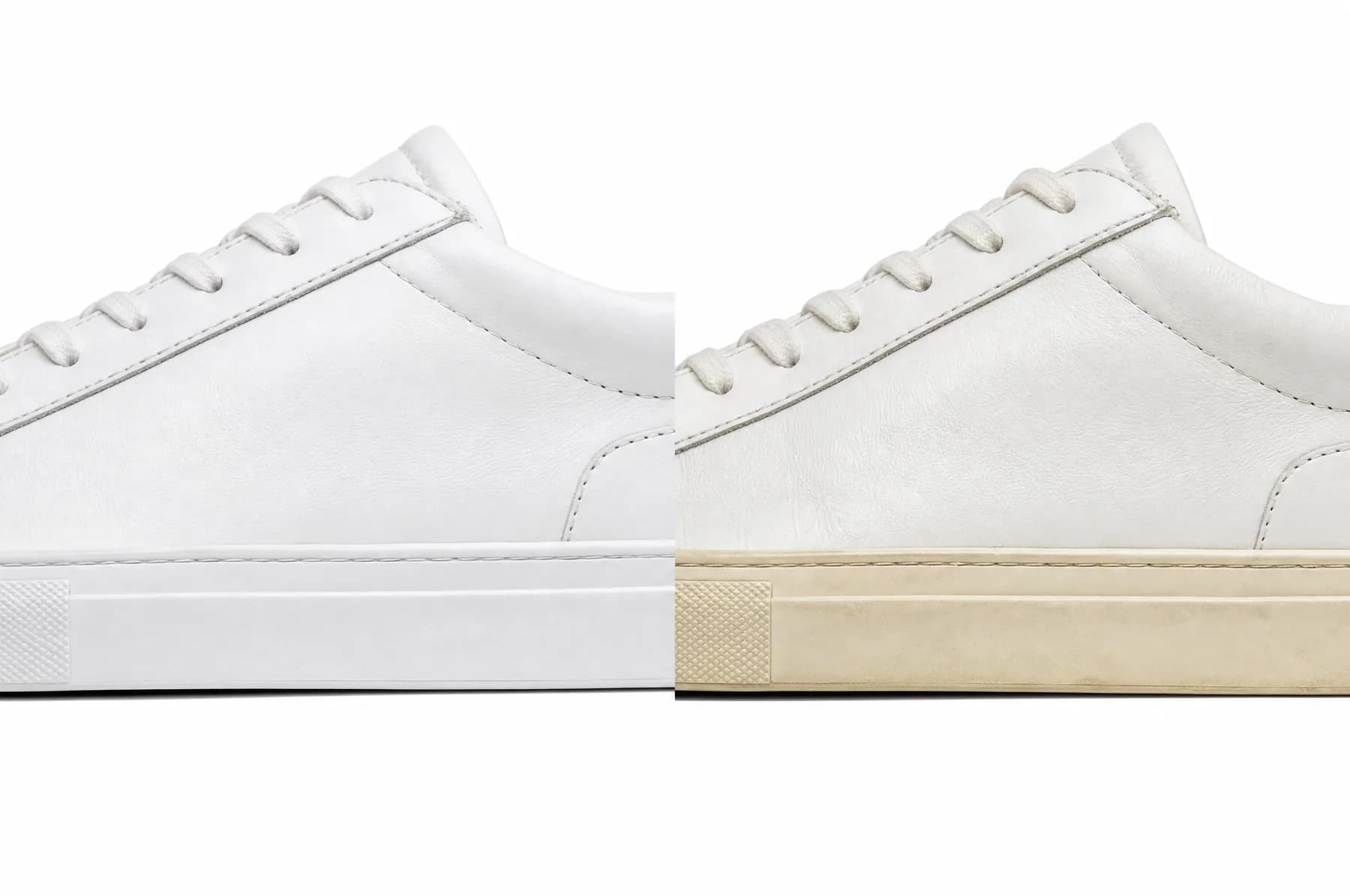
A new white leather shoe beside the same model after a year, visibly warmer in tone

amarelecimento

Couro will still yellow

White leather and the white rubber under it both warm with age and ultraviolet light. The label says couro and outros materiais; neither word says anything about colour holding. Slowing it down is possible. Stopping it is not, and we make no claim that it is.

Not a defect: a midsole gone creamy over a summer. A defect: a single sharp-edged yellow patch appearing within weeks.

Deep flex creases across the forefoot of a worn white leather shoe

vincos

Couro will still crease

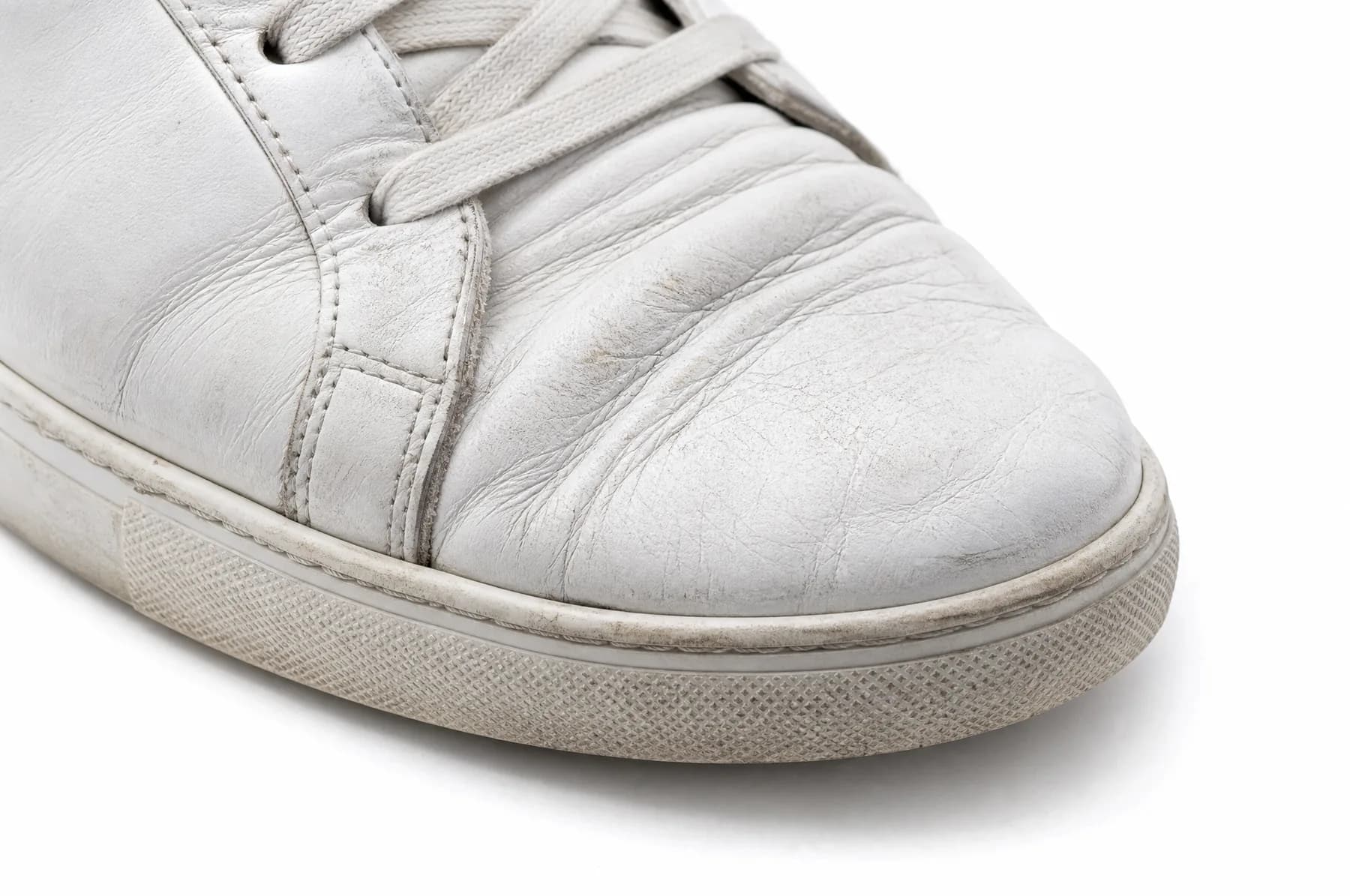
The vamp folds where your foot folds, from the first wears. Softer leather creases sooner and more sharply, and a thicker hide creases later and more coarsely. Both crease. A pair with no creases is a pair nobody has walked in.

Not a defect: deep parallel folds across the forefoot. A defect: a crease that has split through the hide so you can see the lining.

An oil stain and a faint dye transfer remaining on white leather after cleaning

limites de limpeza

Some marks stay

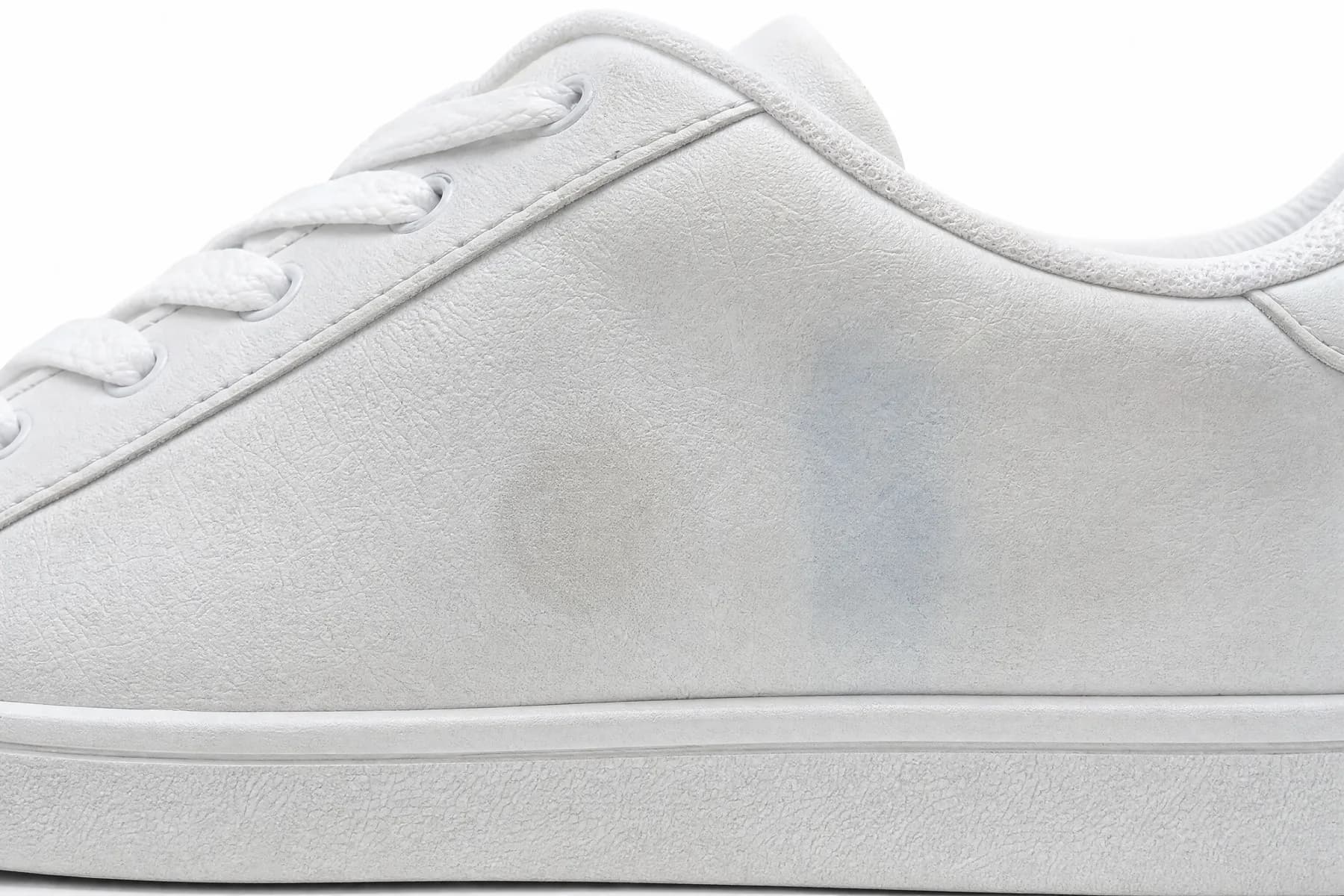
Dust, dry scuffs and most water-based marks come off every material here. Oil, grease, ink and dye lifted from dark denim sink into the surface and generally do not come out, whatever the class on the label says.

Not a defect: a blue shadow along the collar of a pale pair worn with new indigo. A defect: colour coming out of our lining onto your sock.

We can only treat these as expected behaviour because they are printed on the product page before you buy, above the price. A trader who mentions this only after a complaint is describing a defect, not a characteristic.

05

Questions this raises.

Is suede leather?
Yes. Suede is hide with the flesh side raised into a nap, and nubuck is hide with the grain side sanded. Both keep the fibrous structure of the skin, so both are couro under the Directive. Neither behaves like smooth leather in the rain, which is why we give the specific material under the class as well.
Why does the outsole row always say outros materiais?
Because every sole we make is rubber, and rubber is none of leather, coated leather or textile. The Directive gives four classes, and rubber falls into the fourth. A leather outsole belongs to a welted dress shoe, not to a cupsole or a vulcanised casual shoe.
What is the difference between couro and couro revestido?
The thickness of the surface coating. Up to 0.15 mm it is still couro. Above that, and up to one third of the total thickness, it is couro revestido — leather underneath, a finish on top. Beyond one third it stops being leather at all under the Directive. A coated surface wipes clean more easily and it resists solvent much less well.
What if no single material makes up 80% of a component?
The Directive requires the two principal materials to be declared instead. That happens once in our range, on the E-03 Retro Runner, whose upper is roughly 55% nylon panel and 45% suede overlay. Its first row carries both classes rather than pretending one of them dominates.
Does the label tell me how good the shoe is?
No, and this is worth being blunt about. The label tells you what the shoe is made of, not how well it was made. A thin leather and a thick one both read couro. That is why every product page gives the specific material and its thickness underneath the statutory class, rather than stopping at the word the law requires.
Where is the label on the shoe?
Sewn into the tongue on every pair here. It is also printed on the box. You are looking at a photograph of the real one on every product page, as the second image.

Now use it.

Three segments, four options each, with a live count on every one.

Filter on the label