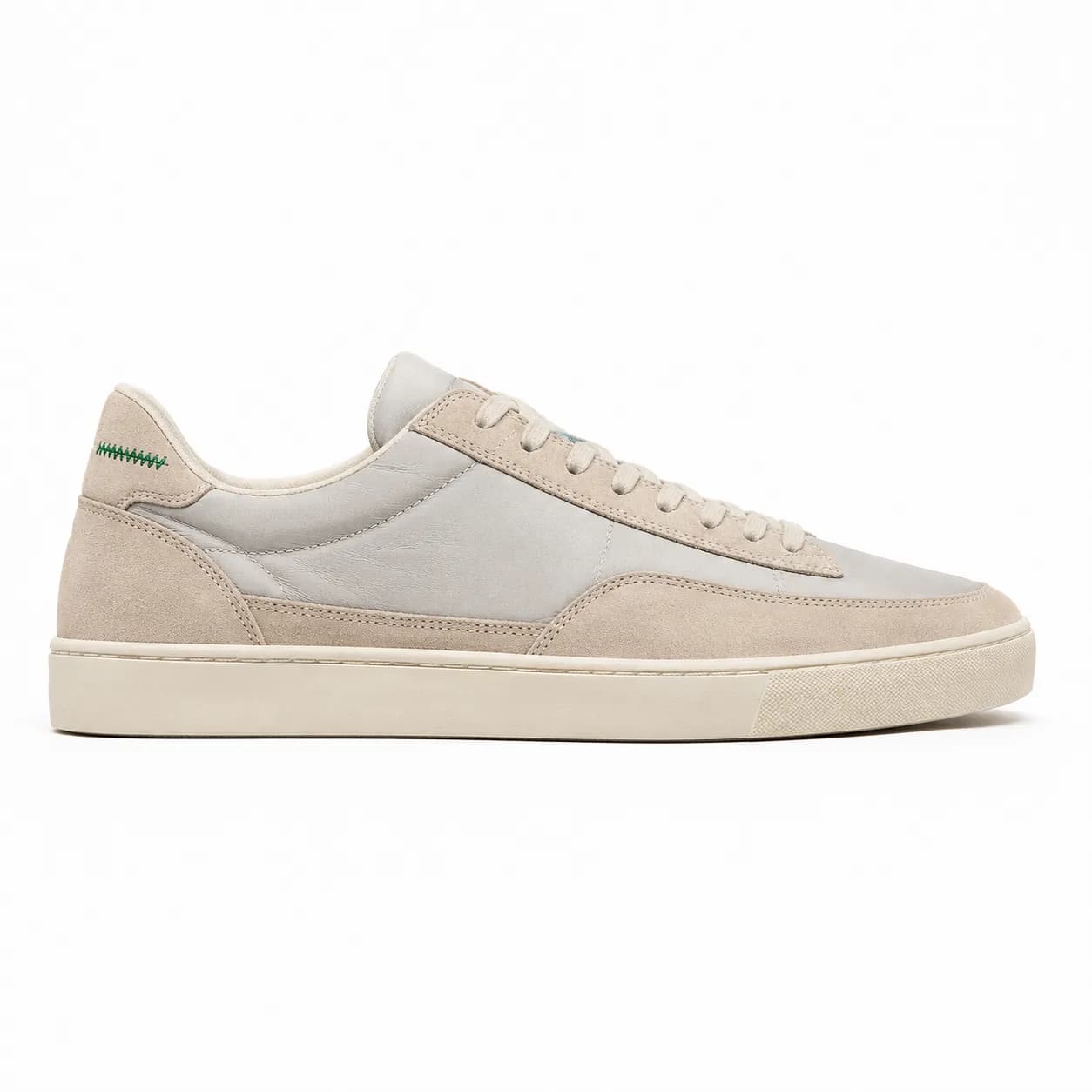
 Side profile
Statutory notation
Parte superior: têxtil e couro · Forro e palmilha: têxtil · Sola: outros materiais
Upper: textile and leather · Lining and insock: textile · Outsole: other materials
E-03 — Line E — cupsole
Retro Runner
A nylon-and-suede upper cut in an old running shape. It is a casual shoe with a retro outline. It is not running equipment and we make no performance claim for it.
$168USD, one-off purchase
Material label — Directive 94/11/EC
| Componente | Material |
|---|---|
| parte superiorupper | têxtiltextilecouroleatherNylon panel upper approx. 55%, cattle suede overlays approx. 45% |
| forro e palmilhalining and insock | têxtiltextileUnbleached cotton drill lining, cotton-faced foam insock |
| solaoutsole | outros materiaisother materialsMoulded rubber cupsole with a compression-moulded EVA wedge |
Declared class is the material making up at least 80% of that component. What each class covers
Cannot be re-soled
The upper is cemented inside a moulded rubber cup. The join is permanent: removing the sole destroys the bottom of the upper. When the tread is worn through, the pair has reached the end of its life. What that means for the guarantee
Adding does not open the cart. The count in the header goes up by one.
- Free standard shipping over $129. Below that it is $12. Delivery windows
- 14 days to withdraw without giving a reason. Try them indoors on carpet. Livre resolução
- 3-year legal guarantee of conformity under Portuguese law. Garantia
- Livro de Reclamações Eletrónico
Specification
Everything we measured.
Figures are taken from a size EU 42 unless a range is given, and they are the same figures we hold in production.
Build
- 01
- Nylon panel upper with suede overlays at toe, eyestay and heel.
- 02
- Neither material reaches 80 percent of the upper, so the label declares both — this is the only shoe here with a two-material row.
- 03
- Flat rubber outsole with no plate, no foam system and no return mechanism of any kind.
- 04
- The shape is borrowed from an era, not from a product. Nothing here imitates a specific model.
Dimensions
- Sole thickness, forefoot
- 24 mm
- Sole thickness, heel
- 32 mm
- Last
- Standard
- Forefoot width, EU 42
- 98 mm
- Construction
- cupsole
- Re-soleable
- No — the join is permanent
- Country of manufacture
- Country of manufacture is printed on the box and on the sewn-in label inside each pair.
Chemical compliance
- Chromium VI in leather
- ≤ 3 mg/kg
- Azo dyes
- Within REACH Annex XVII limits
- Nickel release, metal eyelets
- Within REACH Annex XVII limits
Measured size table
| EU | Foot length | Forefoot width |
|---|---|---|
| 36 | 22.7 cm | 88.4 mm |
| 37 | 23.4 cm | 90.0 mm |
| 38 | 24.0 cm | 91.6 mm |
| 39 | 24.7 cm | 93.2 mm |
| 40 | 25.3 cm | 94.8 mm |
| 41 | 26.0 cm | 96.4 mm |
| 42 | 26.7 cm | 98.0 mm |
| 43 | 27.3 cm | 99.6 mm |
| 44 | 28.0 cm | 101.2 mm |
| 45 | 28.7 cm | 102.8 mm |
| 46 | 29.3 cm | 104.4 mm |
Standard last. If this measures narrow for you, the wide-fit models add about 7 mm across the ball.
How this pair is cleaned, and what will not come out.
Suede and nubuck
- 01Let mud dry completely. Wet mud pushes into the nap; dry mud brushes off.
- 02Brush the whole panel with a brass or crepe brush, always in the same direction.
- 03Work dry marks with a crepe rubber eraser, then brush the crumbs away.
- 04For a water mark, dampen the entire panel evenly rather than spot-treating, then dry it flat and brush the nap back up.
- 05Re-apply a protector spray after cleaning, and always before the first wear.
Comes out
- Dry mud and dust
- Scuffs where the nap has been flattened rather than removed
- Light water marks, if the whole panel is treated evenly
- Salt marks
Stays
- Oil and grease — on nap they spread further and faster than on smooth leather
- Dye transfer
- Areas where the nap has been abraded away to the base, which cannot be regrown
- Marks set by heat drying
- Never put these in a washing machine.
- Never use a smooth-leather cream or wax on nap: it mats the fibres flat and does not come back.
- Never spot-clean with water on one small area only. Treat the whole panel or you trade a stain for a ring.
- Never use a brass brush on smooth leather.
Cotton canvas and woven textile
- 01Remove the laces and the insock and wash both separately by hand.
- 02Brush dry dirt out of the weave with a medium brush.
- 03Work cool water and a little neutral detergent into the fabric with a soft brush, in small circles.
- 04Rinse by wiping with a clean damp cloth several times. Do not hold the shoe under a tap.
- 05Stuff with white paper — coloured paper transfers dye into wet canvas — and dry in the shade for a full day.
Comes out
- Mud and dust
- Most water-based food and drink marks caught early
- Grass marks, partially
- Surface grime across the whole upper, which lifts evenly if you treat the whole panel
Stays
- Oil and grease, which sit between the yarns rather than on them
- Ink and dye transfer
- Yellowing of undyed cotton, which bleach makes worse rather than better
- Stretch: canvas that has given does not come back
- Never put these in a washing machine or a tumble dryer. Heat and the drum separate the sole from the upper.
- Never use bleach or a brightener on undyed cotton.
- Never dry them in direct sun, which drives yellowing.
Rubber midsole and outsole
- 01Work a stiff short-bristle brush with foam cleaner along the midsole, not across it.
- 02Run the brush into the join between sole and upper, where the grey collects first.
- 03Wipe the foam off before it dries, or it leaves a tidemark of its own.
- 04For the tread, a brush and plain water is enough. Do not soak the shoe to clean the bottom of it.
Comes out
- Grey street film, which is most of what makes a white midsole look old
- Scuffs from kerbs, mostly
- Marks at the join between sole and upper
Stays
- Yellowing of the rubber itself, which is oxidation through the material rather than dirt on it
- Cuts and gouges in the rubber
- Tar
- Never use acetone or a solvent on rubber: it softens the compound and it attacks the cement at the join.
- Never soak a shoe to clean its sole.
- Never use a whitening product that relies on bleach. It sets the yellow rather than lifting it.
Why the sole is permanent.
A stitched joint can be unpicked and re-made. A bonded one cannot. Both of the constructions we use are bonded, and that is a property of this kind of shoe rather than a shortcut in ours.
What this material actually needs
Matched to the label above rather than to whatever we would like to shift.
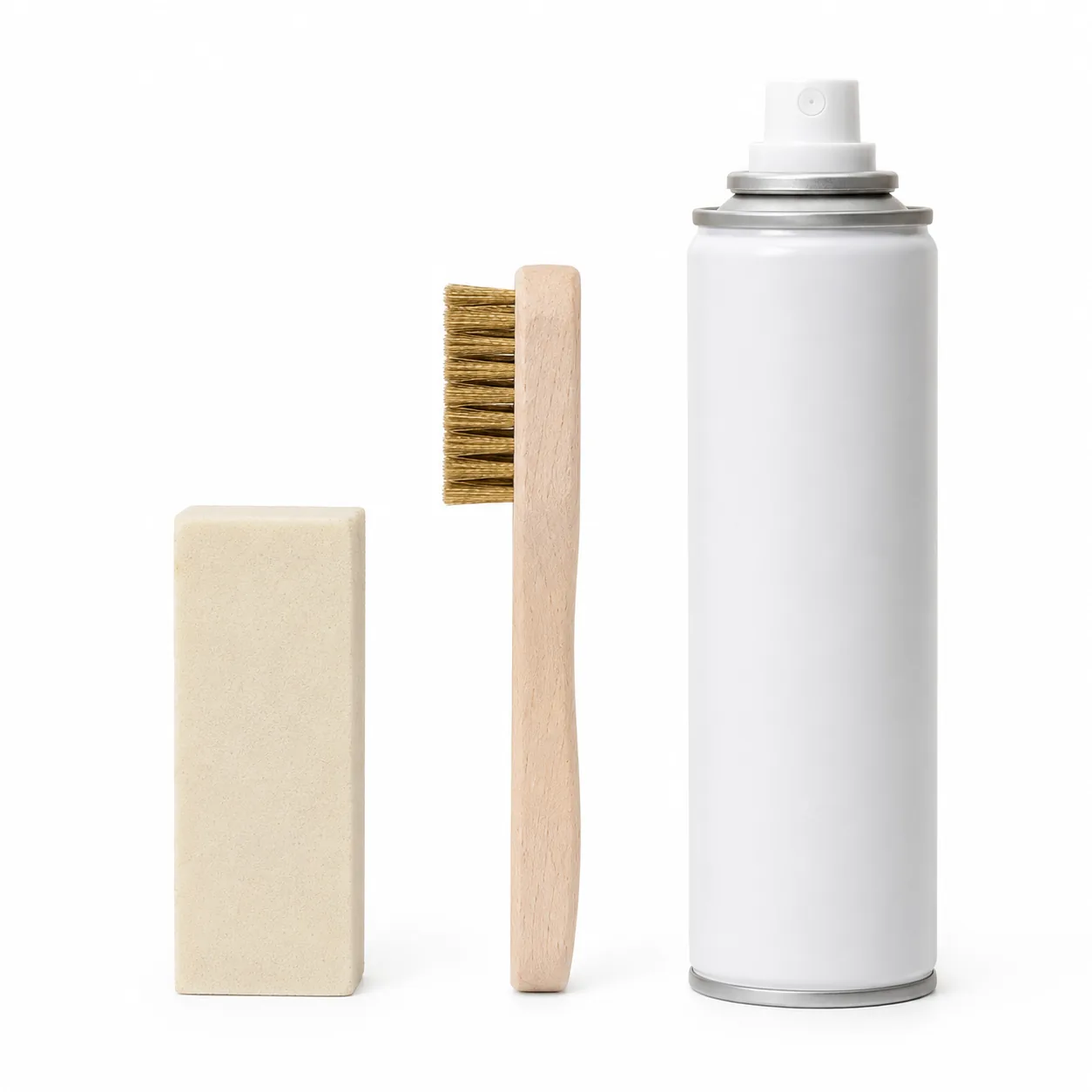
Not footwear — composition listed
F-03
Eraser, brass brush and protector spray. The nap needs abrasion and lifting, not washing, which is why none of this is wet.
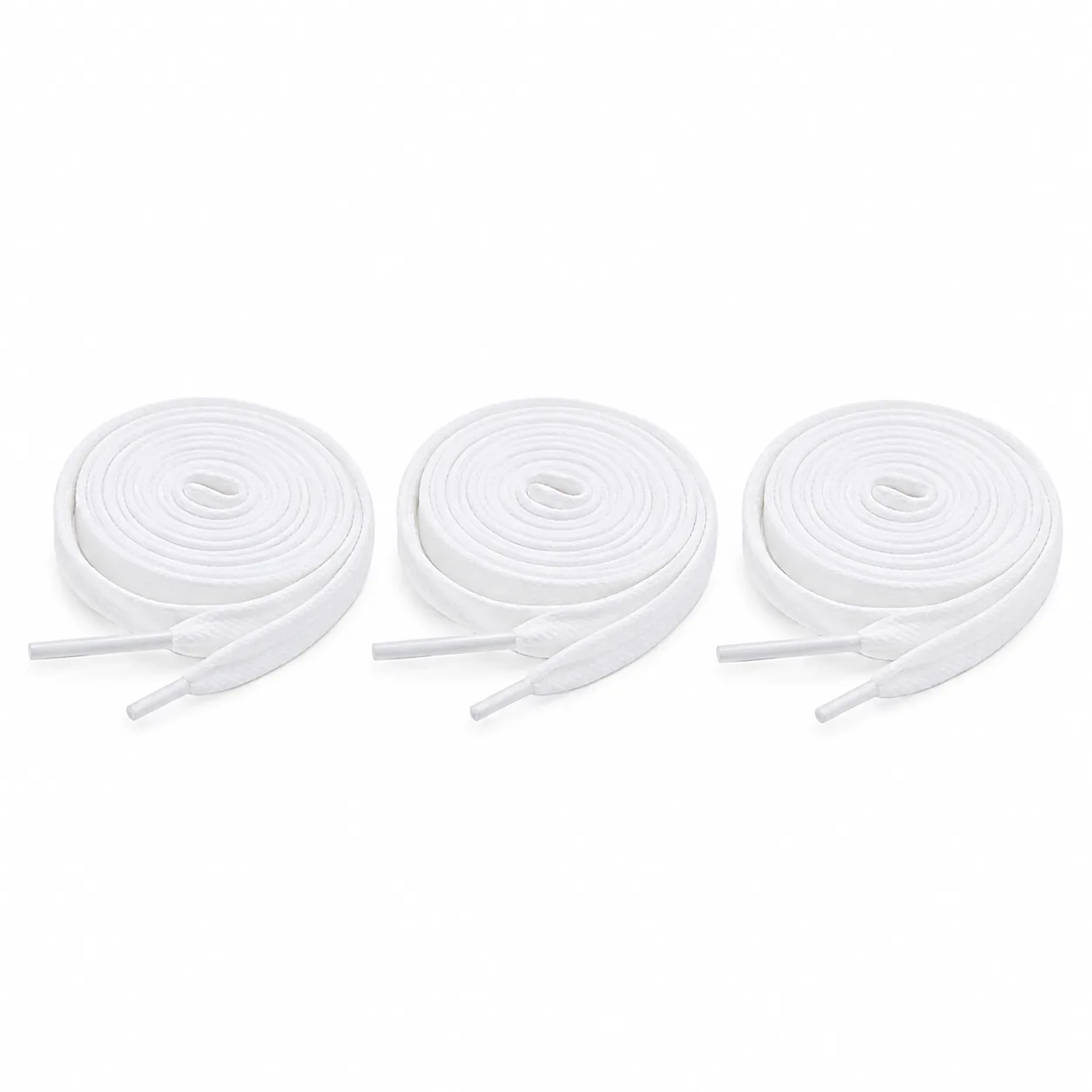
Not footwear — composition listed
F-01 · White
Three pairs of flat cotton laces, 120 cm, the same ones fitted to every low-top here.